
Diagnostic Lab Claim Denials Jumped 40% in 2025, New XiFin Research Report Finds
Analysis of 30 million claims shows denials rising across every insurer group, prior authorization denials doubling for
Press Release Disclaimer: This is a press release distributed through the XPR Media network. It has not been independently verified by our newsroom.


Denials of clinical laboratory, molecular diagnostic, and genomics claims rose to 11.2% in 2025 from 8.0% the year before, a 40% jump that erased two years of improvement, according to the recently released 2026 Payor Denial Impact Report from XiFin, Inc., a leader in AI-enabled revenue cycle management (RCM). The report is based on an analysis of more than 30 million claims processed through XiFin’s Empower RCM solution, which serves 11 of the 15 largest laboratories in the United States.1 It also provides segment-specific benchmarks across clinical laboratory, molecular, pathology, and hospital outreach providers.
This press release features multimedia. View the full release here: https://www.businesswire.com/news/home/20261008305451/en/
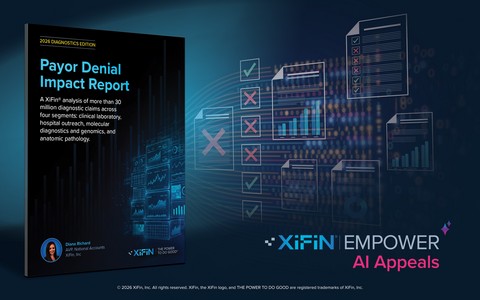
XiFin’s 2026 Payor Denial Impact Report finds that lab denial rates rose 40%. Empower AI Appeals makes previously cost-prohibitive appeals practical to pursue while reducing manual appeal preparation time by up to 90%.
“Health plans have modernized how they review claims. Decisions now happen in a fraction of a second with payors’ use of AI. Most healthcare providers haven’t, until now, had access to comparable AI-powered applications, and the numbers show it: more denials and more staff time to get paid for tests that were ordered and performed,” said Kyle Fetter, Chief Operating Officer of XiFin. “Labs, molecular diagnostic providers, and pathology groups are absorbing that cost, even as patients are picking up a larger share of a bill that too often started with a denial.”
Key findings of the 2026 Payor Denial Impact Report
- Denials rose across every insurer type, including traditional Medicare. Traditional Medicare had the lowest denial rate, at 3.4% of claims. Medicare Advantage and Medicaid managed care plans, along with other insurer groups, delivered significant increases in denial rates.
- Prior authorization denials for genetic and molecular tests more than doubled, to 27.6% of all denials, from 13.1% in 2021. Insurers have pledged to reduce prior authorization requirements, but denials have now shifted to “technical” and “payment integrity” categories, such as code mismatches and documentation deficiencies.2 The equivalent amount of denials now arrives under different denial codes.
- Procedure Not Paid Separately, a “bundling edit” in which the payor treats the test as already included in another paid service, is now the No. 1 reason clinical lab claims are denied. Payment rules that combine tests performed together into a single payment accounted for 59% of clinical lab denials, up from 33% in 2018, nearly double. Bundling also accounted for more than 61% of hospital outreach laboratory denials, a segment the report analyzed separately for the first time.
- Patients are paying more, and providers are collecting less. The patient’s share of the bill rose to 30% in 2025 from 26% in 2023, while the portion of those balances actually collected fell to 9% from 12%.
Appealing denials pays
In 2025, a successful appeal returned an average of $1684 for molecular/genetic tests, $235 for pathology, $171 for clinical and $48 for hospital outreach labs. But successful appeals often take two or three attempts, with each one taking a trained staff member 20 minutes or more to complete. With 84% of insurers using artificial intelligence in daily operations,3 an automated denial costs little to issue, while every appeal costs the provider real resources to respond. Many providers write off claims they could have won rather than expend staff time on them. Patients feel it, too. A Commonwealth Fund survey found that 41% of people whose prior authorization was denied said it delayed their care, and 43% with a denied claim said it left them or a family member in medical debt.4
“When a provider keeps winning the same kinds of appeals, it can be a sign that those claims should never have been denied in the first place. Often, the claims met the payor’s policy, medical necessity, and documentation requirements all along,” said Fetter. “That pattern creates an opening for providers and insurers to have a different conversation, one focused on reducing the denials that are consistently overturned on appeal, thereby reducing the administrative burden of this process for both sides of the cost equation.”
XiFin® Empower AI Appeals helps tackle growing denial volumes—works alongside any billing or RCM system
To help providers address growing volumes of denials and reimbursement pressure, Empower AI Appeals helps automate the appeals process by reading and interpreting insurer policies, denial reasons, and patient clinical records, then generating and filing comprehensive, patient-specific appeals in minutes.
Providers choose which appeals go out automatically and which are subject to a human review first. It also draws on industry-trusted data from the XiFin Empower ecosystem, including how results were coded and submitted, and how that compares with similar claims from other providers, so each appeal is payor-aligned and can be submitted electronically to payors. Empower AI Appeals offers providers a proven way to put AI to work in a high-impact workflow, without an experimental AI pilot or costly in-house build.
Frost & Sullivan recently recognized XiFin in its Frost Radar™ for Revenue Cycle Management Operations in North America. “Our Frost Radar™ analysis highlighted XiFin’s specialized expertise in diagnostic and ancillary revenue cycle management and its commitment to AI-enabled workflows. As denial complexity increases, providers need technology that makes more reimbursement economically practical to pursue. By pairing diagnostic denial insights with agentic AI appeal automation, XiFin is addressing a critical business challenge: expanding revenue recovery capacity while reducing the manual effort required to prepare each appeal,” said Sagar Mukhekar, Industry Analyst, Healthcare and Life Sciences, Frost & Sullivan.
In early use, customers have cut the time to prepare a complex appeal from more than 20 minutes to under three, and one customer reduced its appeal costs by 60%.5 Labs, pathology groups and molecular diagnostics providers can add agentic appeals automation to their existing environment without the cost and disruption of switching billing or RCM platforms.
“Every hour a healthcare provider and their administrative staff don’t spend chasing a denial is an hour they can spend on patients and the physicians who depend on its results,” Fetter added. “Providers shouldn’t have to replace their RCM system to keep pace with automated denials. Empower AI Appeals meets them where they are. That’s what we mean by ‘The Power to Do Good.’”
Learn more
- Download the 2026 Payor Denial Impact Report
- See what your organization could recover with the XiFin Empower AI Appeals Opportunity Explorer
About XiFin
XiFin is a healthcare information technology company that empowers organizations to navigate an evolving and increasingly complex healthcare landscape. The XiFin Empower AI RCM ecosystem and trusted data employ active intelligence and automation to reduce manual touches, coordinate workflows, accelerate customer innovation, and improve financial outcomes. Our comprehensive set of solutions—spanning revenue cycle management, clinical workflow enablement, laboratory information systems, and patient engagement—deliver The Power to Do Good® so that healthcare organizations can do more good for more patients. XiFin was ranked the #1 client-rated RCM partner for cross-ancillary and outpatient laboratory services for the seventh consecutive year in Black Book Market Research’s 2025 RCM Outsourcing Survey. Visit www.XiFin.com, follow XiFin on LinkedIn, or subscribe to the XiFin blog to learn more.
1 XiFin, 2026 Payor Denial Impact Report: Diagnostics Edition. Analysis of more than 30 million diagnostic claims with 2025 dates of service across clinical laboratories, hospital outreach laboratories, molecular and genomic, and anatomic pathology providers.
2 Centers for Medicare & Medicaid Services. HHS Secretary Kennedy, CMS Administrator Oz secure industry pledge to fix broken prior authorization system. June 23, 2025.
3 National Association of Insurance Commissioners. NAIC survey: majority of health insurers use artificial intelligence or machine learning in operations. May 20, 2025.
4 The Commonwealth Fund. How health insurance coverage denials affect Americans: findings from the Commonwealth Fund 2025 Affordability Survey and focus groups. June 4, 2026.
5 XiFin customer results as reported in the 2026 Payor Denial Impact Report. Results vary by organization, payor mix, and appeal volume.
View source version on businesswire.com: https://www.businesswire.com/news/home/20261008305451/en/
Media gallery


